

Canine heart disease
Disease overview
Heart disease affects approximately 10% of all dogs. The majority of cases are acquired, degenerative diseases of the heart valve or the heart muscle. Heart murmurs are the earliest sign of cardiac disease, so it is important to detect them early and grade them for the best outcomes.
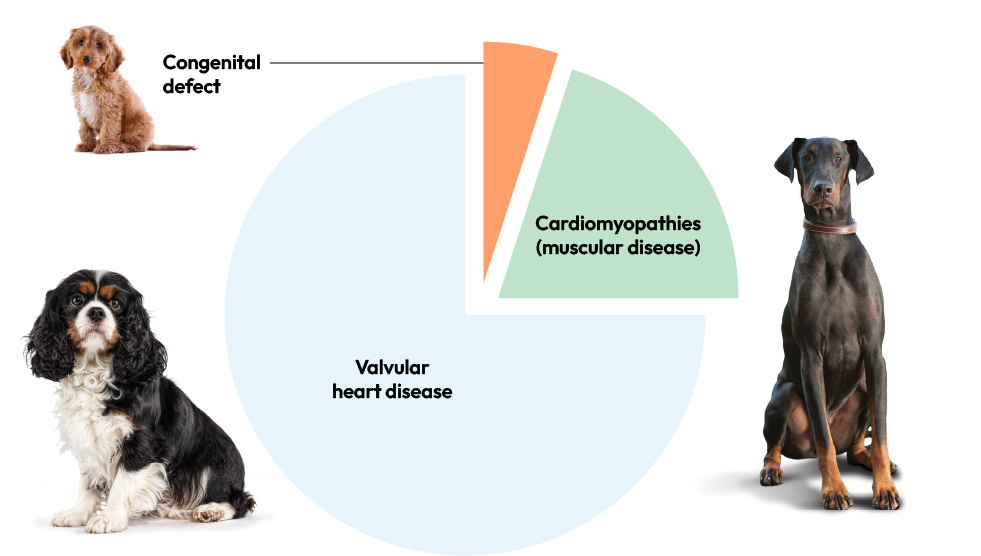
Types of Canine Heart Disease
-
The most common cause of canine heart problems is valvular disease.1,2 Myxomatous mitral valve disease (MMVD) causes the mitral valve to thicken and become uneven, so the valve cannot form a perfect seal and blood leaks backwards in the wrong direction. MMVD more commonly affects small breeds,3 for example Cavalier King Charles Spaniels, Boston Terriers, Chihuahuas, Fox Terriers, Miniature Pinschers, Poodles, Pekingese, Pomeranians and Whippets.
Key symptoms include a left apical systolic heart murmur resulting from mitral regurgitation.1 MMVD is a progressive condition that leads to congestive heart failure in a substantial proportion of affected dogs,4 and, if left untreated, high mortality within 6–14 months of onset.5
-
In dilated cardiomyopathy (DCM), heart muscle cells do not function properly. The heart dilates secondary to decreased function, enlarging and weakening with walls that are stretched and thin. Dilation of the valve annulus causes leakage at the mitral valve resulting in a murmur. This disease progresses quickly. DCM more commonly affects large breeds,6,7 for example Doberman Pinschers, Great Danes, Afghan Hounds, Boxers, Cocker Spaniels, Dalmations, Irish Wolfhounds, Newfoundlands, Saint Bernards and Scottish Deerhounds.
-
Congenital heart disease (CHD) in dogs refers to structural heart defects present at birth, often inherited or stemming from developmental issues. Although relatively uncommon (approx. 1.6% of dogs), CHD is serious, with commonly reported forms including e.g. pulmonic stenosis (PS), subaortic stenosis (SAS) and patent ductus arteriosus (PDA).8 Clinical signs include lethargy, exercise intolerance, coughing and syncope, typically appearing in puppies or young dogs.
Murmur grading
Heart murmurs are commonly graded out of 6, depending on murmur intensity. For development of CANINEBEAT® AI, a simplified* Levine scale was used for ease of use in daily practice.

*The Levine scale categorises heart murmurs into 6 grades. Profs Wess, Häggström and Assoc. Professor Ljungvall have simplified the Levine scale into 3 levels.
**likelihood of Stage B1 is 95%9
Dogs with relevant cardiomegaly in MMVD typically have a “moderate” or “loud” murmur (Grade ≥3/6).10
Challenges with heart murmur detection
Hard to hear:
Many murmurs are subtle and occur at frequencies below the human hearing threshold.11 These can be missed during routine check-ups, especially in busy clinics or with restless patients. Early-stage heart disease is often asymptomatic and subtle murmurs can go unnoticed and remain undetected.
Missed murmurs:
Research has shown the limitations of standard auscultation. In human medicine, clinician sensitivity for detecting valvular heart disease has been reported at just 46.2%, versus 92.3% when using AI-enabled digital stethoscope,12 and similar limitations are assumed to apply in veterinary practice. This challenge is reflected in veterinary studies.
One study found that every second murmur is missed by recent graduate veterinarians (<1 year).13 Another study found that general practice veterinarians found only 1 out of 97 soft heart murmurs in puppies that were detected by a specialist cardiologist.14 Higher murmur detection rates were seen with more experienced clinicians in a study of cardiologists, referral veterinarians, veterinary students and recent graduates. The recent graduates missed 25–75% of systolic murmurs.15




References: 1. Atkins C, Bonagura J, Ettinger S, et al. Guidelines for the diagnosis and treatment of canine chronic valvular heart disease. J Vet Intern Med. 2009;23:1142–1150. 2. Guglielmini C. Cardiovascular diseases in the aging dog: diagnostic and therapeutic problems. Vet Res Commun. 2003;27 Suppl 1:555–560. 3. Rush JE. Chronic valvular heart disease in dogs. Proceedings from the 26th Annual Waltham Diets/OSU Symposium for the Treatment of Small Animal Cardiology; October 19–20, 2002. 4. Keene BW, Atkins CE, Bonagura JD, et al. ACVIM consensus guidelines for the diagnosis and treatment of myxomatous mitral valve disease in dogs. J Vet Intern Med. 2019;33:1127–1140. 5. Borgarelli M and Buchanan JW. Historical review, epidemiology and natural history of degenerative mitral valve disease. J Vet Cardiol 2012;14(1):93–101. 6. O’Grady MR, Minors SL, O’Sullivan ML, Horne R. Effect of pimobendan on case fatality rate in Doberman pinschers with congestive heart failure caused by dilated cardiomyopathy. J Vet Intern Med. 2008;22:897–904. 7. Ware WA. Cardiovascular Disease in Small Animal Medicine. Ames, IA: Blackwell Publishing Professional; 2007. 8. Lucina SB, Sarraff AP, Wolf M, et al. Congenital heart disease in dogs: A retrospective study of 95 cases. Topics Compan Anim Med 2021;43. 9. The Listen Study. 2026. Publication in submission. 10. Ljungvall I, Rishniw M, Porciello F, et al. Murmur intensity in small-breed dogs with myxomatous mitral valve disease reflects disease severity. J Small Anim Pract. 2014;55:545-50. 11. Christer Ahlström (2006). Processing of the Phonocardiographic Signal − Methods for the Intelligent Stethoscope. Doctoral dissertation. Department of Biomedical Engineering, Linköpings universitet, Sweden. 12. Rancier M et al. Artificial-intelligence-enabled digital stethoscope improves point-of-care screening for moderate-to-severe valvular heart disease. European Heart Journal - Digital Health. 2026;7(2):ztag003. 13. Pedersen HD, Haggstrom J, Falk T, et al. Auscultation in mild mitral regurgitation in dogs: observer variation, effects of physical maneuvers, and agreement with color Doppler echocardiography and phonocardiography. J Vet Intern Med 1999;13:56-64. 14. van Staveren MDB, Szatmari V. Detecting and recording cardiac murmurs in clinically healthy puppies in first opinion veterinary practice at the first health check. Acta Vet Scand 2020;62:37. 15. Mullowney D, Fuentes VL, Barfield D. Cardiac auscultation skills in final year veterinary students and recent veterinary graduates, referral hospital veterinary surgeons and veterinary cardiologists or cardiology residents. Vet Rec 2021;189:e305.
